
Under current feedstock and credit conditions, when does HEFA-SAF undercut fossil jet at the offtake gate?
Problem statement: This note applies DG-PFF to define the HEFA feasibility boundary under realistic cost, carbon-intensity, and credit assumptions. It answers whether any viable parity region exists before project teams proceed to operational survivability testing.
DG-PFF Application Marker
- Parity condition: MSP_HEFA <= delivered fossil benchmark.
- Viability region: Mapped explicitly in Figure 2 as the region below the parity boundary.
- Fragility quantified: Figure 4 reports the fragility slope d(MSP)/d(feedstock).
- Collapse threshold: Parity is invalid above feedstock ~$931/tonne (base credit), CI > ~37.4 gCO2e/MJ, or effective credit < ~$1.35/gal.
- Parity persistence rule: Parity without persistence is not viability.
Product A: Decision Brief (3-Minute Screen)
Decision Summary
DG-PFF Execution Trace
- Parity condition defined against delivered fossil benchmark.
- Viability region mapped using the Figure 2 parity boundary.
- Fragility quantified using the Figure 4 marginal parity penalty.
- Collapse thresholds identified for feedstock, CI, and effective credit.
- Go/No-Go decision handling produced in the decision summary outputs.
Decision question
At what production cost, carbon-intensity, and credit-realization combinations does HEFA-SAF beat fossil jet at the offtake gate?
Decision owner and deadline
- Decision owner: Investor / strategy lead / policy analyst
- Decision deadline: Prior to feedstock contracting, JV economics lock, or scale-up capital commitment.
Applicability
This note applies a structural feasibility screen for HEFA-SAF parity against fossil jet. It is designed for pre-FID and portfolio screening where go/no-go boundaries are required.
Analytical lens (DG-PFF)
- Parity condition: HEFA MSP <= fossil jet price on a delivered basis.
- Fragility condition: MSP sensitivity to lipid price ($/tonne), effective credit value ($/gal), and CI-linked credit compression.
- Framework principle: Parity alone is insufficient; viability requires persistence of parity under perturbation.
Confidence / robustness tag
Confidence: Medium (benchmark-anchored deterministic sweep; dispatch, contracting, and full LCA coupling not yet integrated), benchmark run dated March 20, 2026.
Primary outputs (non-negotiable)
- Benchmark framing figure
- Primary parity map
- MSP response curve with parity threshold
- Fragility penalty figure
- Decision summary figure
Figure 1 - Benchmark Framing
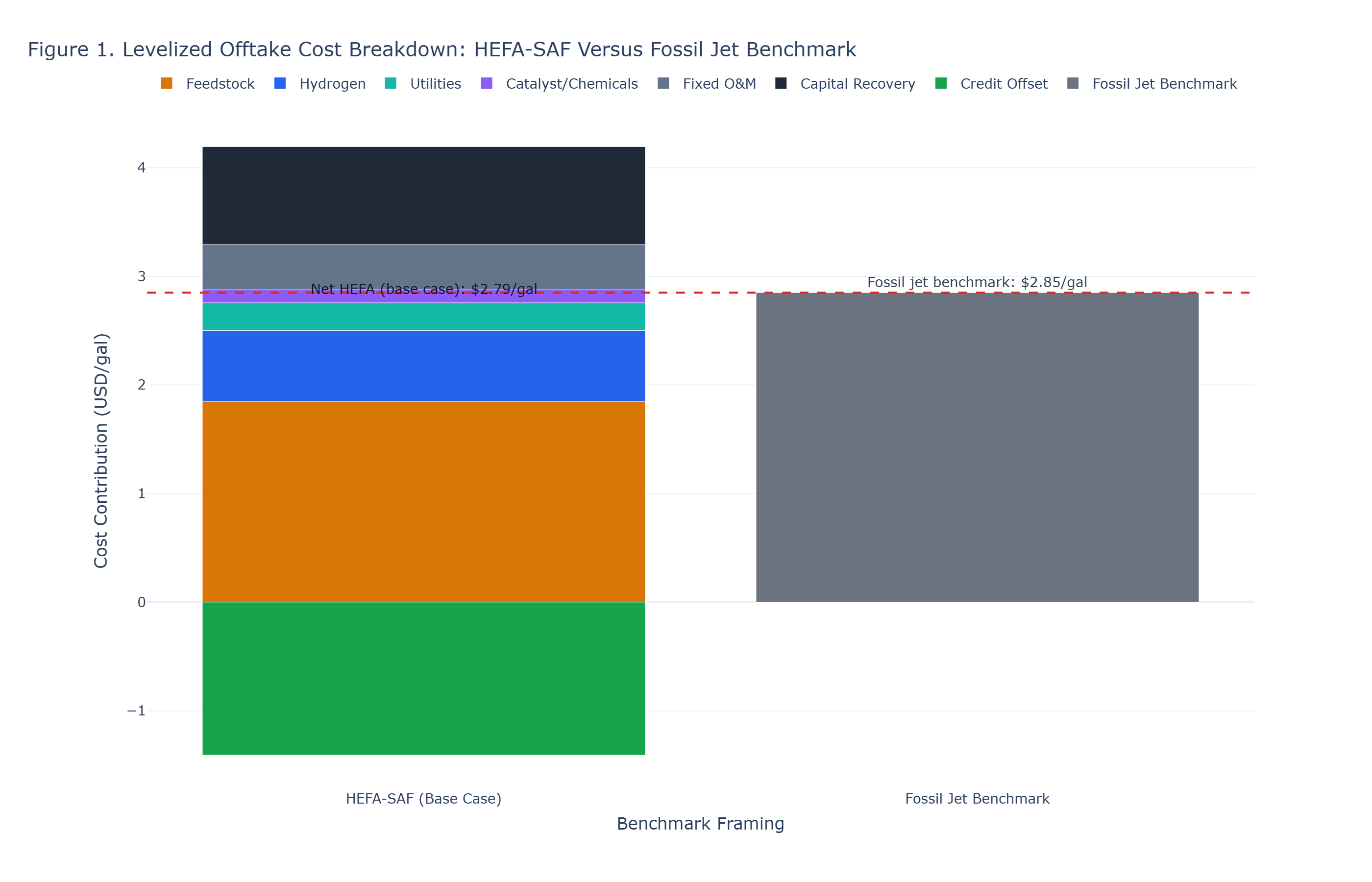
Figure 1: Base-case benchmark framing. HEFA-SAF cost stack is compared against fossil jet benchmark, with credit offset shown explicitly as a negative segment.
Decision statement
- In the base case, HEFA parity is tight versus fossil jet and structurally exposed to feedstock escalation despite modeled credit support.
Figure 2 - Primary Parity Map
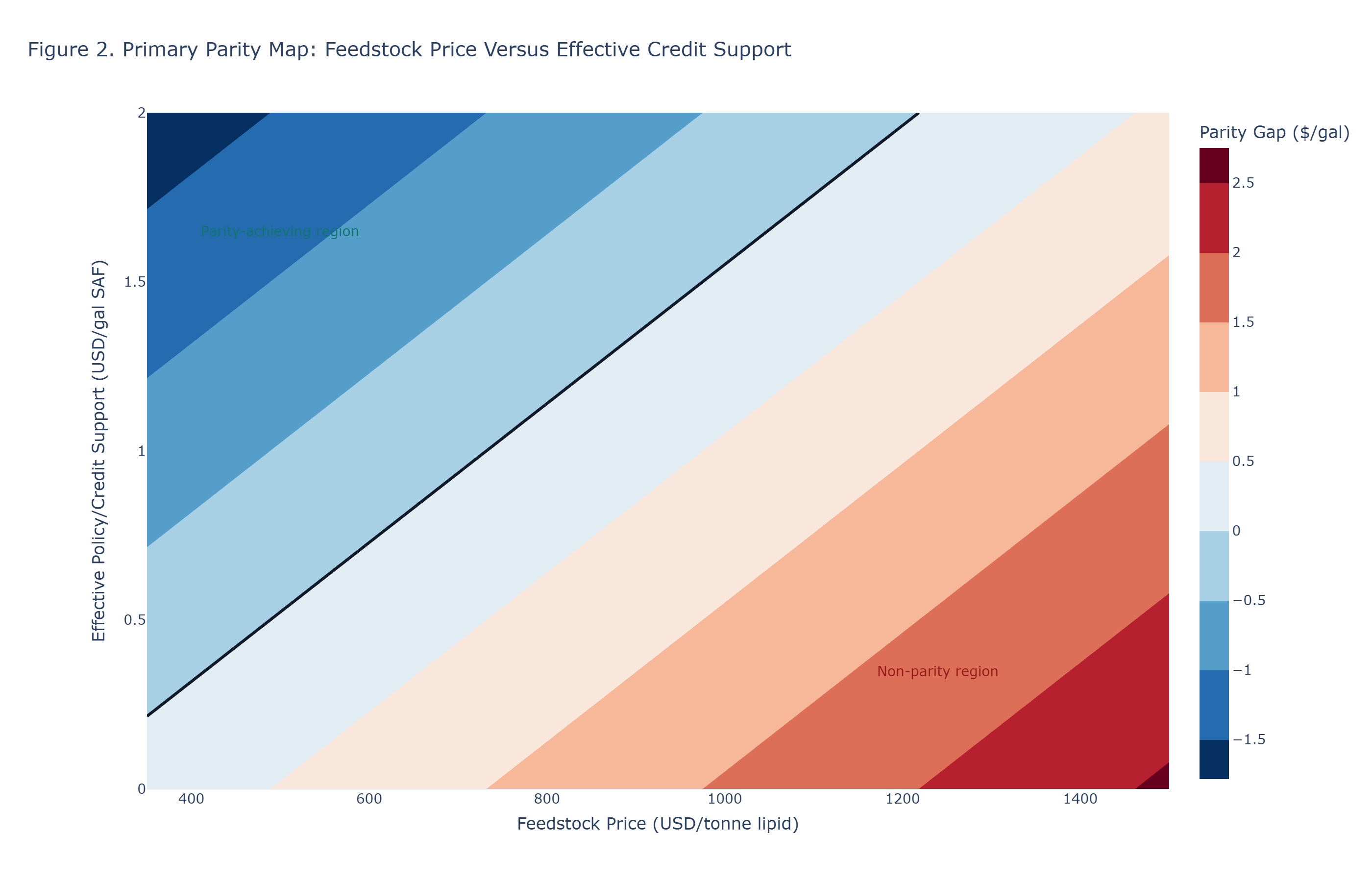
Figure 2: Primary parity map. The zero-gap contour marks the viability boundary. Regions below the boundary achieve parity with fossil jet, while regions above do not.
Decision statement
- The parity boundary defines a narrow viability region: at modeled base credit support, parity requires feedstock <= ~$931/tonne; above this collapse threshold, the viable region is invalid.
Figure 3 - MSP Response with Parity Threshold
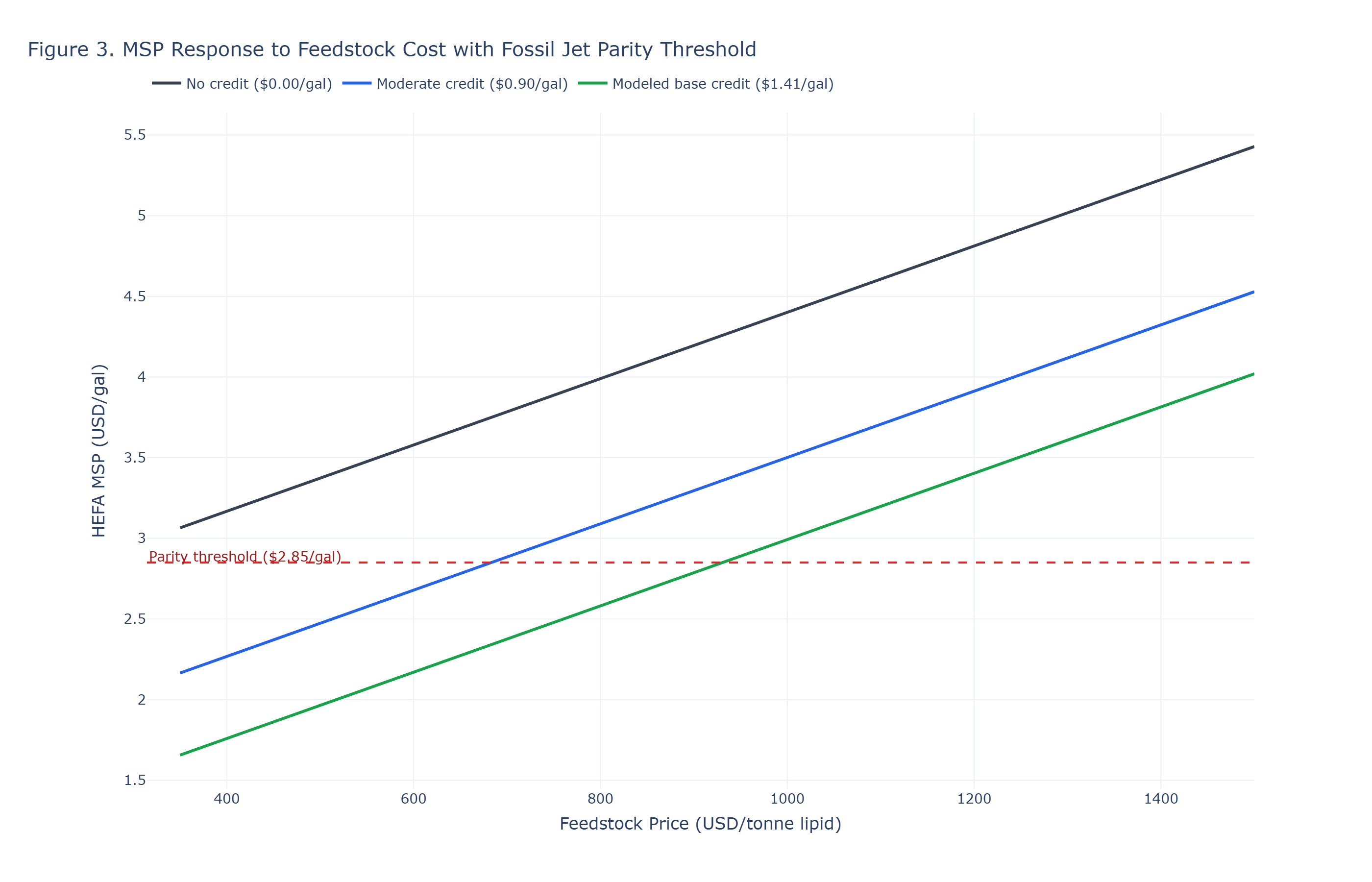
Figure 3: MSP response curves under no-credit, moderate-credit, and modeled-credit scenarios with fossil jet parity threshold shown explicitly.
Decision statement
- The parity boundary shifts with credit support, but parity persistence remains narrow; moderate feedstock escalation invalidates the viability region across constrained-credit cases.
Figure 4 - Fragility Penalty from Feedstock Escalation
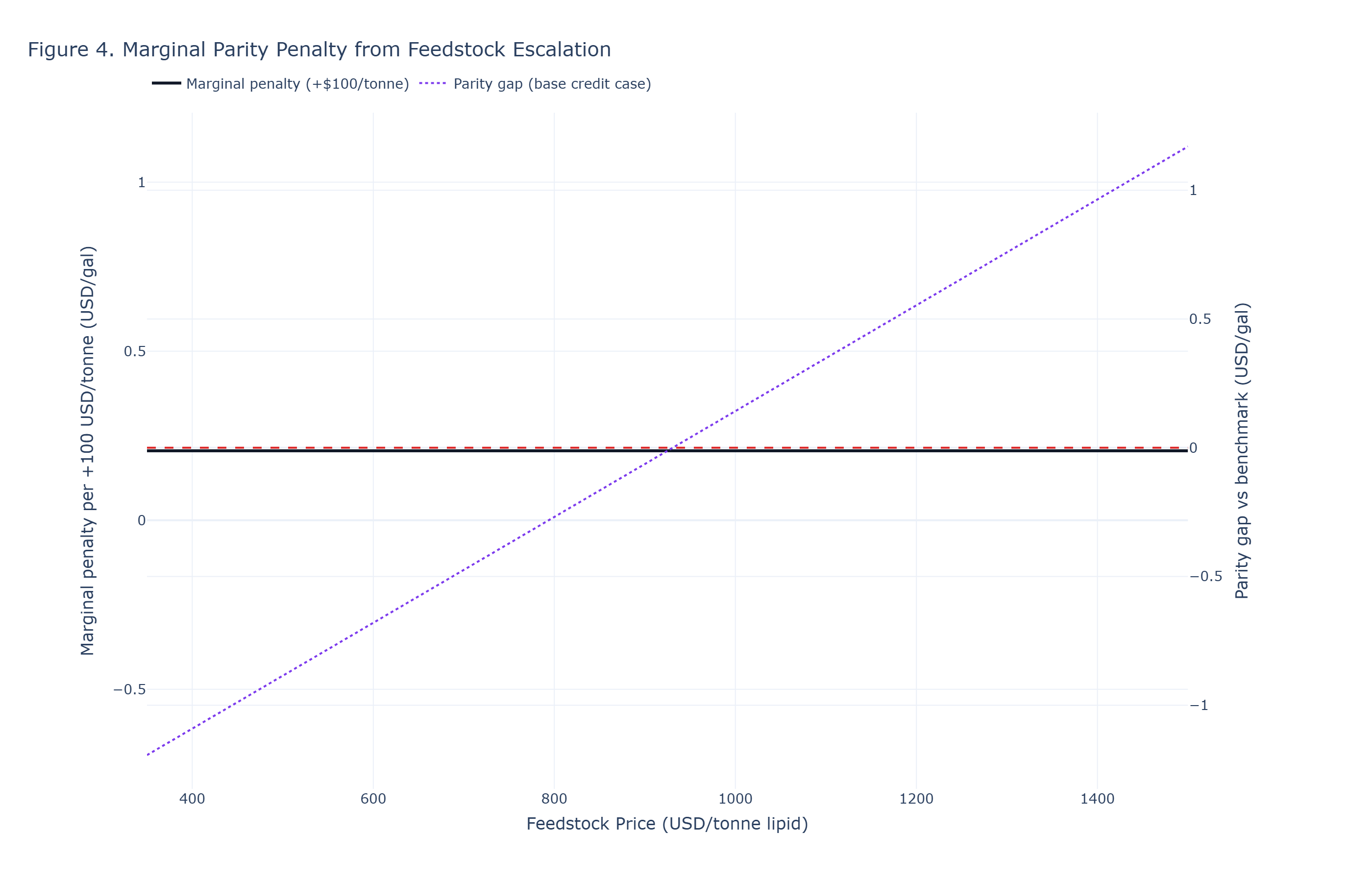
Figure 4: This figure quantifies the rate at which economic parity deteriorates as feedstock prices rise, providing a direct fragility measure rather than a simple threshold condition.
Decision statement
- d(MSP)/d(feedstock) ~= 0.00206 $/gal per $/tonne (equivalently +$0.206/gal per +$100/tonne), indicating persistent structural fragility.
Figure 5 - Decision Summary Figure
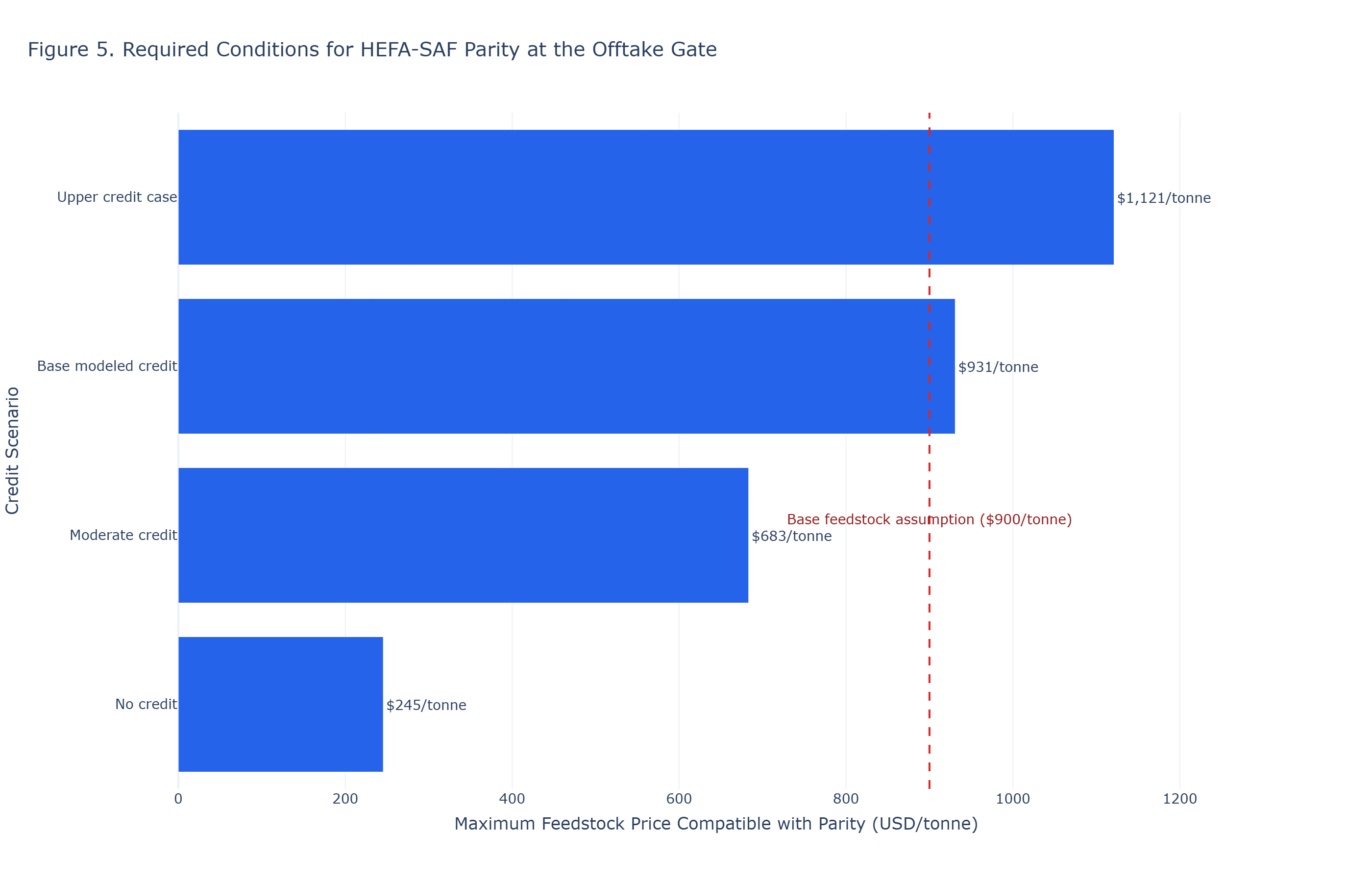
Figure 5: Decision summary of required conditions. Maximum feedstock prices compatible with parity are shown by credit scenario for board-level Go/No-Go screening.
Decision statement
- Under moderate and low credit support, parity is either highly constrained or impossible at realistic feedstock prices.
Structural Claim
HEFA-SAF parity is structurally constrained under current feedstock distributions: the viability region exists only in a narrow slice of low lipid pricing with sustained credit support, and collapses under moderate feedstock escalation.
Constraint Statement (DG-PFF)
Under realistic lipid-price conditions, HEFA-SAF parity is not broadly achievable; parity persistence requires sustained low feedstock pricing and credit realization above collapse thresholds.
Product B: Technical Note (Audit Trail)
1. Decision Context
This note is the HEFA feasibility boundary layer (Product A: Parity). It identifies whether parity is structurally possible under benchmark-consistent steady-state assumptions before operational survivability stress is applied. Operational degradation variables (dispatch volatility, outage behavior, and runtime instability) are intentionally excluded from this note and should be evaluated in a companion fragility note. This analysis applies the DG-PFF (Parity and Fragility Framework) to evaluate whether HEFA-SAF achieves cost parity under real feedstock and policy conditions.
2. Analytical Lens (DG-PFF)
- Parity condition: MSP_HEFA <= fossil jet delivered benchmark.
- Fragility condition: parity persistence under lipid-price, credit-value, and CI perturbations.
- Decision principle: Parity alone is insufficient; viability requires persistence of parity under perturbation.
3. Parity Claim
The parity claim tested is that HEFA-SAF can undercut fossil jet at the offtake gate under current feedstock and credit conditions.
4. Parity Metric
Parity is defined at the boundary where net delivered HEFA-SAF cost equals delivered fossil jet benchmark cost under stated CI and credit assumptions.
5. Fragility Metric
Fragility in this parity-layer note is reported as structural collapse thresholds, not operational degradation dynamics. Parity collapses when any of the following conditions are breached: feedstock > ~$931/tonne, CI > ~37.4 gCO2e/MJ, or effective credit < ~$1.35/gal. These collapse conditions explicitly invalidate the parity-defined viable region even when other assumptions remain favorable.
5A. Parity-Fragility Relationship
Product A defines the structural parity region under steady-state assumptions; Product B must test that region under realistic operating and market constraints and explicitly invalidate portions that fail collapse criteria. In this note, the structural invalidation boundaries are feedstock > ~$931/tonne, CI > ~37.4 gCO2e/MJ, and effective credit < ~$1.35/gal.
6. Methods and Traceability
- Fossil jet benchmark basis: $2.85/gal reference benchmark used in the parity equation (
assets/data/notes/hefa-cost-parity-vs-fossil-jet/hefa_parity_inputs.json). - Feedstock benchmark basis: Base feedstock assumption $900/tonne with solved parity threshold of ~$930.8/tonne.
- Hydrogen and utility assumptions: Hydrogen ~$0.65/gal, utilities ~$0.256/gal, catalyst ~$0.12/gal, fixed OPEX ~$0.416/gal, annualized CAPEX ~$0.903/gal.
- Credit stack basis and scenario logic: Max credit modeled at $1.80/gal with CI-linked linear compression from 20 to 89 gCO2e/MJ; decision scenarios include no-credit, moderate-credit ($0.90/gal), modeled base credit (~$1.41/gal), and upper credit case.
- Scenario grid specification: Feedstock sweep $350-$1,500/tonne and effective credit sweep $0.00-$2.00/gal exported to
assets/data/notes/hefa-cost-parity-vs-fossil-jet/parity_surface_grid.csv.
7. Publication Completion Checklist
- Figure 1 benchmark framing complete and annotated
- Figure 2 primary parity map complete with viability boundary language
- Figure 3 MSP response complete with parity-threshold crossings
- Figure 4 fragility-penalty metric complete with labeled slope
- Figure 5 decision summary complete with threshold windows by credit scenario
- Structural claim tied to viability-region collapse
- Decision summary updated with final thresholds and confidence tag
- Explicit parity-fragility relationship statement included (Section 5A)
- Feedstock fragility slope disclosed as a decision output
This analysis applies the DG-PFF Parity Fragility Framework. This analysis extends DG-PFF beyond hydrogen systems, demonstrating applicability to SAF pathways under feedstock-driven cost uncertainty.