
When cheap lipids disappear, how quickly does HEFA-SAF parity fail?
Problem statement: This analysis begins where parity mapping ends. It applies DG-PFF to test how rapidly a parity-positive HEFA case fails when low-cost lipid assumptions are replaced with realistic feedstock distributions.
DG-PFF Application Marker
- Parity condition: MSP_HEFA <= delivered fossil benchmark.
- Viability region: Imported from Product A parity boundary and tested for persistence under distributional stress.
- Fragility quantified: Figure 2 reports parity probability and Figure 3 maps viability-region collapse.
- Collapse threshold: Deterministic collapse at ~$931/tonne (base jet, modeled credit); at $1200/tonne, residual shortfall is ~$0.162/gal even at maximum modeled credit.
- Parity persistence rule: Parity without persistence is not viability.
Product A: Decision Brief (3-Minute Screen)
Decision Summary
DG-PFF Execution Trace
- Parity condition defined against delivered fossil benchmark.
- Product A viability region imported from the parity boundary and stress-tested.
- Fragility quantified using parity probability response and collapse mapping.
- Collapse threshold identified at feedstock breach points with explicit residual gap.
- Go/No-Go exposure classes produced for procurement and credit regimes.
Core decision question
What is the probability that HEFA-SAF retains parity when feedstock prices move from optimistic assumptions to realistic procurement ranges?
Decision owner and timing
- Decision owner: Project developer / lender downside case team / investment committee.
- Decision timing: Prior to feedstock strategy lock, term-sheet finalization, or FID.
Analytical lens (DG-PFF)
- Parity condition: MSP_HEFA <= delivered fossil jet benchmark.
- Fragility condition: parity persistence under feedstock-price distribution shifts.
- Decision principle: Parity alone is insufficient; viability requires persistence of parity under perturbation.
Required outputs (non-negotiable)
- Lipid-price distribution used in screening
- Parity probability
P(MSP <= jet)across distribution - Collapse threshold where parity disappears
- Invalidation map of parity-defined viable region
- Structured Go/No-Go output for procurement strategy
Output 1 - Lipid Price Distribution
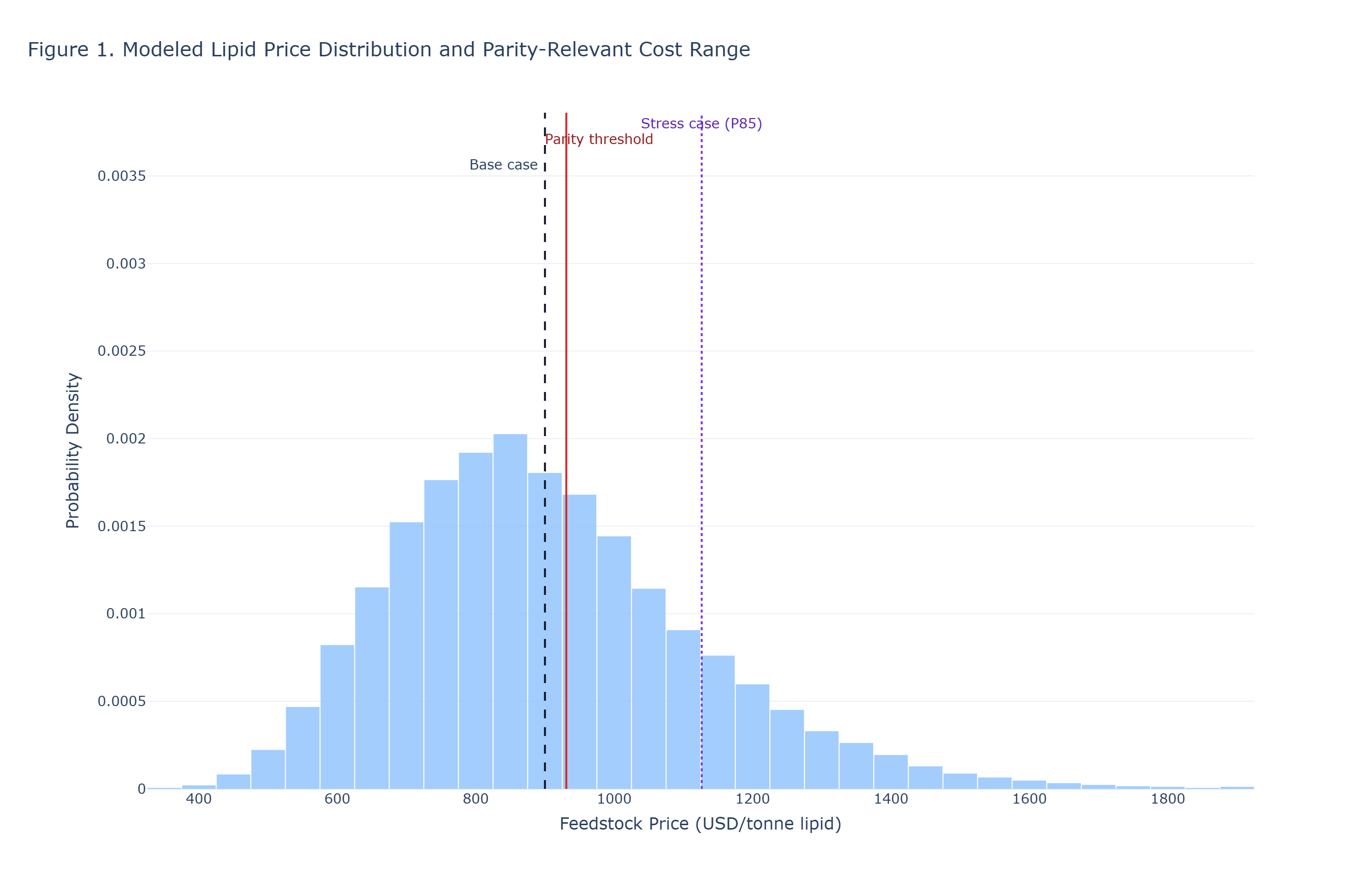
Figure 1: Feedstock distribution framing. The parity threshold is shown against modeled lipid-price density to indicate how often market conditions support parity.
Required form
- Empirical or scenario distribution of lipid prices used for screening.
- Must include source basis and recency date.
Decision statement
- Under the modeled distribution, ~60.1% of feedstock outcomes remain below the parity-supporting threshold (~$931/tonne).
Output 2 - Parity Probability
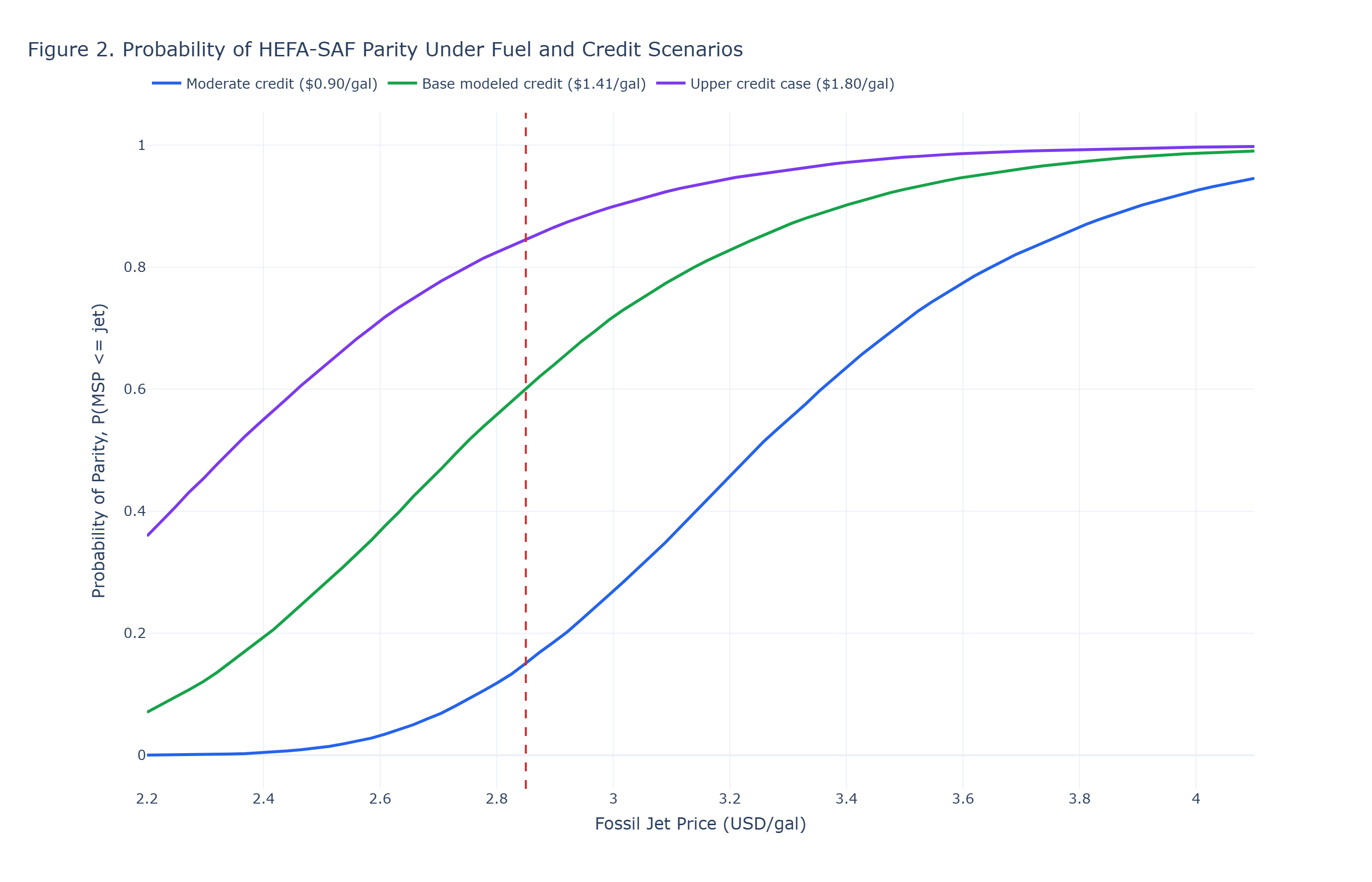
Figure 2: Probability of parity under credit and fuel-price scenarios. This converts deterministic parity into a decision-risk metric.
Required form
P(MSP <= jet)under base and stressed credit assumptions.
Decision statement
- Under base modeled credit assumptions, parity probability is ~60.1%; under moderate-credit stress it falls to ~15.0% (a 45.1 percentage-point collapse in parity persistence).
Output 3 - Collapse Threshold
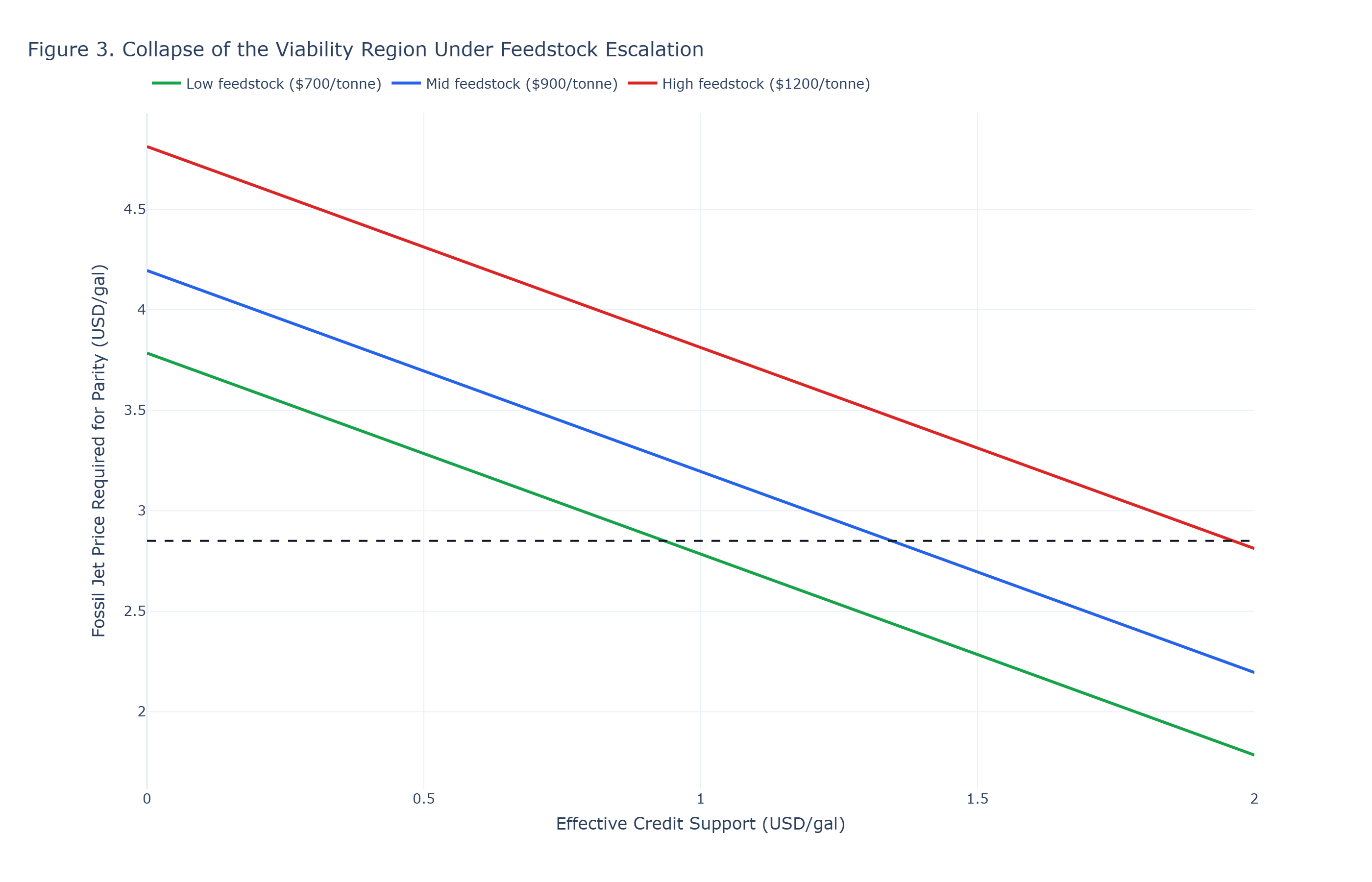
Figure 3: As feedstock costs rise, the viability region contracts and eventually disappears, indicating boundary collapse rather than a simple upward shift in cost.
Required form
- Feedstock price threshold above which parity is no longer observed.
Decision statement
- Above ~$931/tonne (base jet, modeled credit), parity collapses for the deterministic boundary case. At $1200/tonne feedstock, even maximum modeled credit leaves an unrecovered shortfall of ~$0.162/gal.
Output 4 - Fragility Trigger Threshold
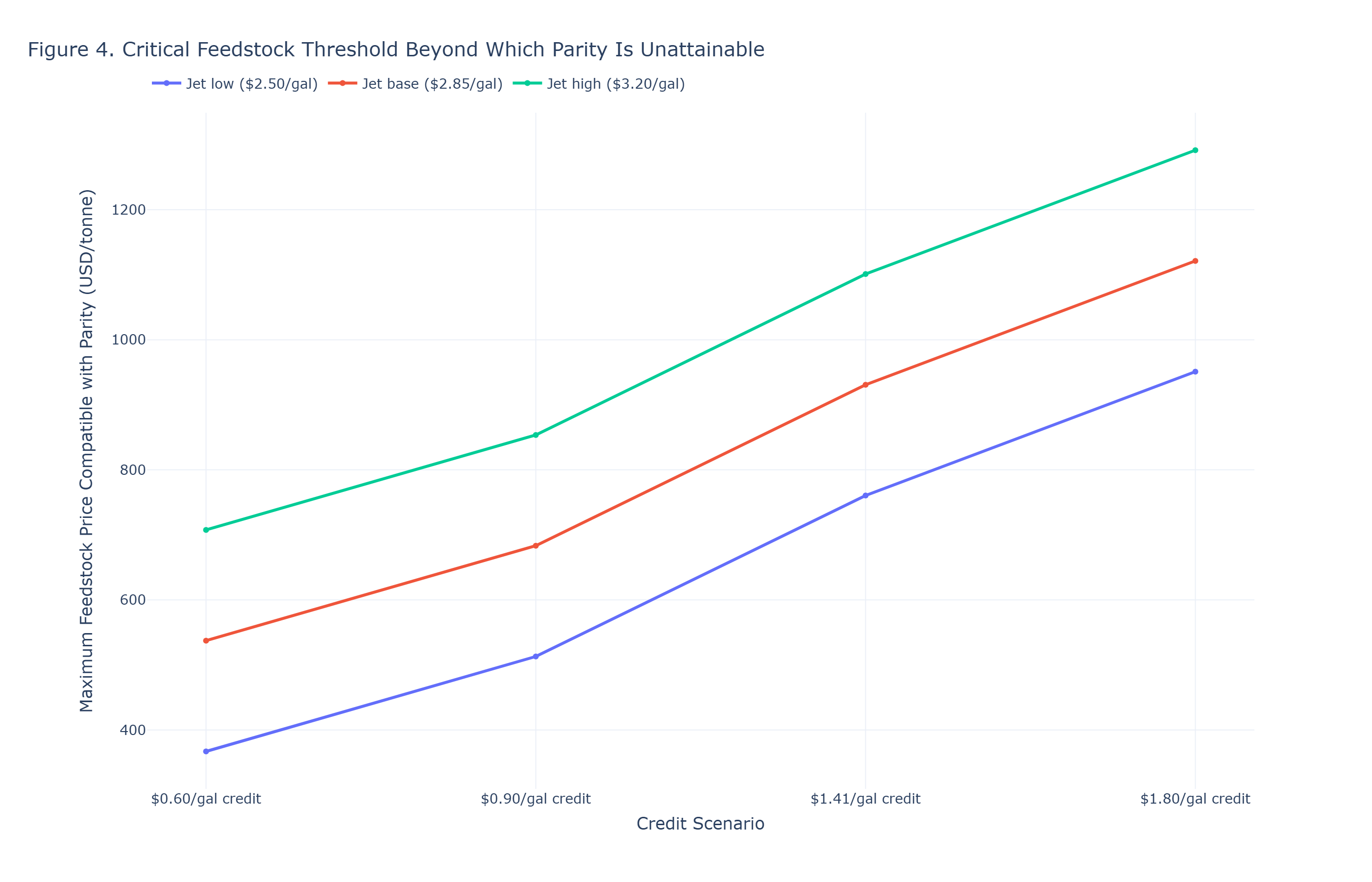
Figure 4: Critical feedstock ceilings for parity by credit and fossil-price regime. This is the trigger-threshold translation for diligence use.
Required form
- Critical feedstock threshold by credit scenario (and at least one jet-price scenario cross-check).
Decision statement
- At base jet benchmark, the parity boundary requires feedstock <= ~$931/tonne under modeled credit support; above this collapse threshold, parity is unattainable without structural redesign.
Output 5 - Decision Exposure Matrix
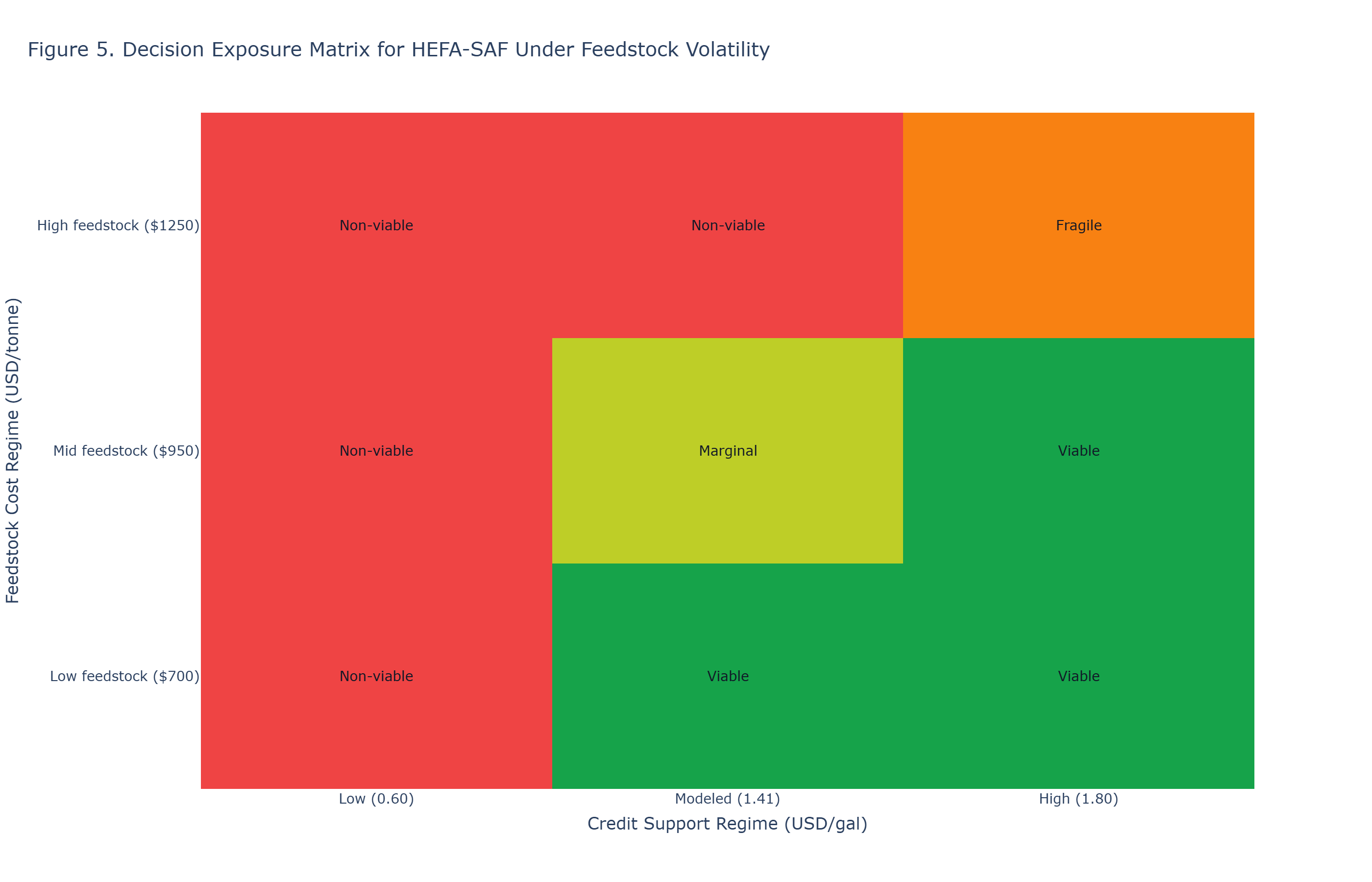
Figure 5: Board-level decision matrix mapping feedstock and credit regimes to viable, marginal, fragile, and non-viable states.
Required form
- 2x2 or 3x3 exposure matrix with explicit regime labels and decision class.
Decision statement
- Under high-feedstock / low-credit regimes, parity status is non-viable, indicating a no-go unless the procurement and credit regime is redesigned.
Structured Go/No-Go Output
| Decision class | Handling | Trigger condition |
|---|---|---|
| Viable | Go | Parity gap <= -$0.15/gal and parity probability remains high under base assumptions |
| Marginal | Conditional Go | Parity gap between -$0.15 and +$0.05/gal; requires procurement and credit-risk mitigation |
| Fragile | Redesign / Defer | Parity gap between +$0.05 and +$0.30/gal; parity persistence is weak under plausible perturbation |
| Non-viable | No-Go | Parity gap > +$0.30/gal or collapse threshold breached |
Current regime highlights from Figure 5:
- Low feedstock / low credit: Non-viable
- Mid feedstock / modeled credit: Marginal
- High feedstock / high credit: Fragile
Constraint Statement (DG-PFF)
Under realistic lipid-price distributions, HEFA-SAF parity persistence is fragile: once feedstock exceeds the ~$931/tonne collapse threshold, the viability region contracts sharply, and at ~$1200/tonne parity remains unattainable even with maximum modeled credit.
Product B: Technical Note (Audit Trail)
1. Decision Context
This note is a Product B fragility-first application of DG-PFF for HEFA-SAF. It evaluates whether parity remains bankable once feedstock uncertainty is represented explicitly.
2. Analytical Lens (DG-PFF)
- Parity condition: MSP_HEFA <= fossil benchmark.
- Fragility condition: collapse of parity probability under feedstock escalation.
- Required relationship: this note must explicitly invalidate portions of Product A parity region under realistic market conditions.
3. Parity Claim Under Distribution
The tested claim is that a parity-positive HEFA case remains decision-grade once feedstock-price uncertainty is represented as a distribution rather than a point estimate.
4. Fragility Metric
Fragility is quantified as:
- Decline rate of parity probability per feedstock-price shift, and
- Collapse threshold where parity probability approaches zero.
5. Parity-Fragility Relationship
This fragility note explicitly invalidates parity-defined viable regions from Product A when feedstock outcomes exceed collapse thresholds, even if other assumptions remain favorable.
6. Decision Classification Bands
Decision-matrix classes are based on parity-gap bands (MSP - fossil benchmark):
- Viable: <= -$0.15/gal
- Marginal: > -$0.15 and <= +$0.05/gal
- Fragile: > +$0.05 and <= +$0.30/gal
- Non-viable: > +$0.30/gal
Band rationale: these ranges convert continuous parity gaps into decision actions for screening, term-sheet diligence, and downside-case governance.
6A. Distribution Source and Methodology
- Distribution type: lognormal synthetic feedstock-price distribution.
- Parameterization: centered around base feedstock assumption ($900/tonne) with
sigma=0.24. - Reproducibility controls: random seed fixed at
42; distribution clipped to [$350, $1900]/tonne. - Data and traceability artifacts:
assets/data/notes/hefa-feedstock-risk-when-cheap-lipids-disappear/feedstock_distribution_samples.csvassets/data/notes/hefa-feedstock-risk-when-cheap-lipids-disappear/hefa_feedstock_fragility_summary.jsonscripts/generate_hefa_feedstock_fragility_figures.py
6B. Parity Probability and Collapse Outputs
- Base modeled credit parity probability (at $2.85/gal fossil benchmark): ~60.1%
- Moderate-credit stress parity probability (at $2.85/gal fossil benchmark): ~15.0%
- Deterministic collapse threshold (base jet, modeled credit): ~$931/tonne
- High-feedstock collapse shortfall: at $1200/tonne, residual gap remains ~$0.162/gal even at maximum modeled credit.
7. Publication Completion Checklist
- Figure 1 feedstock distribution complete with parity threshold marker
- Figure 2 parity probability curves complete with scenario labels
- Figure 3 viability-region collapse figure complete with boundary language
- Figure 4 critical threshold figure complete with units
- Figure 5 decision exposure matrix complete with regime classes
- Decision classification bands disclosed and justified
- Distribution source and methodology disclosed
- Parity probability outputs complete (base + stress)
- Collapse threshold disclosed with units and boundary condition
- Invalidation map included with labeled thresholds
- Structured Go/No-Go output included
- Cross-link to parity note and DG-PFF standard included
This analysis applies the DG-PFF Parity Fragility Framework. This analysis extends DG-PFF beyond hydrogen systems, demonstrating applicability to SAF pathways under feedstock-driven cost uncertainty.