HEFA-SAF Cost Parity vs Fossil Jet: Viability Region Under Feedstock and Credit Constraints
Why feedstock cost and realized credit define a narrow HEFA-SAF parity window.
IQ-AN-SAF-2026-01 · 2026-06-19 · v2.0 · 14 min read
Plain-English takeaway
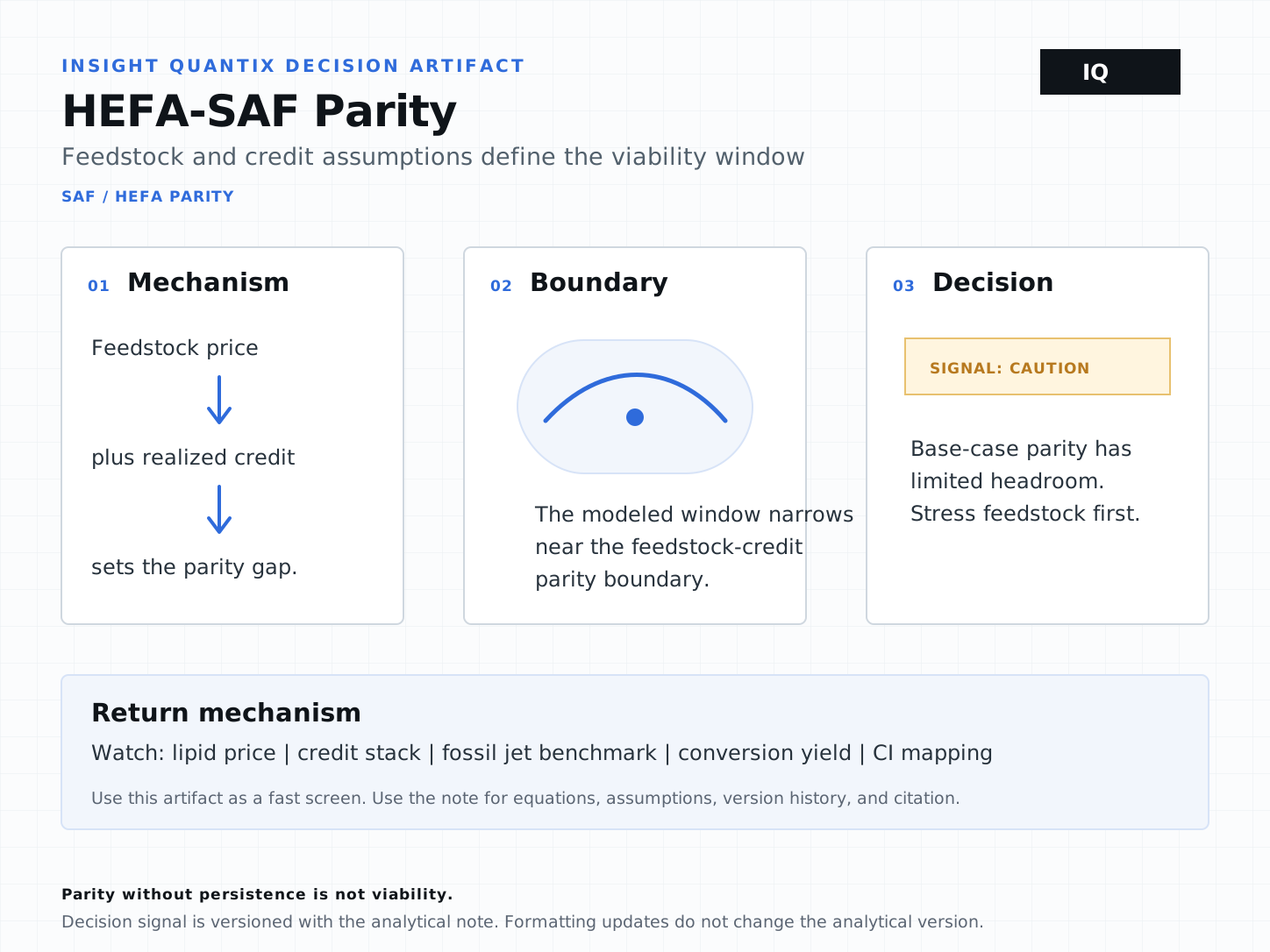
HEFA-SAF parity exists only inside a narrow feedstock-credit window. At the modeled base credit of roughly $1.41/gal, the feedstock ceiling is approximately $931/tonne. The $900/tonne base case therefore retains only about $31/tonne of headroom before parity fails.
Why this matters
Feedstock cost and realized credit value are the primary controls. Carbon intensity and hydrogen cost modify whether the required credit regime remains accessible, but process optimization cannot rescue a case after the modeled feedstock-credit boundary is breached.Parity without persistence is not viability.
Permanent citation rule: cite the named version, stable publication date, URL, and access date. Updated benchmark, policy, sensitivity, method, threshold, or conclusion changes are versioned.
Version note: v2.0 updates structure, navigation, and visual presentation. The benchmark and policy basis remain the source set documented in the technical note; this revision is not a new market-price or policy determination.
Decision
Decision Summary
GO: Modeled parity is available at feedstock at or below roughly $683/tonne with at least moderate realized credit of roughly $0.90/gal, subject to persistence testing.
CONDITIONAL / EDGE: Between roughly $683 and $931/tonne, parity requires stronger realized credit. At the $900/tonne base-feedstock case, the modeled base credit is roughly $1.41/gal and the collapse threshold is roughly $1.35/gal.
NO-GO: Feedstock above roughly $931/tonne at modeled base credit; effective credit below roughly $1.35/gal at $900/tonne feedstock; or CI above roughly 37.4 gCO2e/MJ under the modeled CI-credit mapping at $900/tonne feedstock.
What drives the result
Feedstock price: Each $100/tonne increase raises modeled MSP by approximately $0.206/gal.
Carbon intensity: CI affects parity through the modeled credit-realization mapping and must be interpreted conditionally.
Base-case headroom: Only roughly $31/tonne separates the $900/tonne assumption from the $931/tonne collapse threshold.
Decision
Kill Conditions
Treat the following modeled combinations as No-Go unless feedstock, credit, or pathway structure changes:
Feedstock exceeds roughly $931/tonne at the modeled base credit of roughly $1.41/gal.
Effective credit falls below roughly $1.35/gal at the $900/tonne base-feedstock case.
CI exceeds roughly 37.4 gCO2e/MJ under the modeled CI-credit mapping at the $900/tonne base-feedstock case.
The case has no durable feedstock or credit controls. A near-degenerate base case should not be treated as persistent parity without stress testing.
Context
Technical Note (Audit Trail)
The sections below preserve the parity equation, boundary logic, feedstock sensitivity, CI-credit mapping, assumptions, figures, and reproducibility record supporting the decision screen.
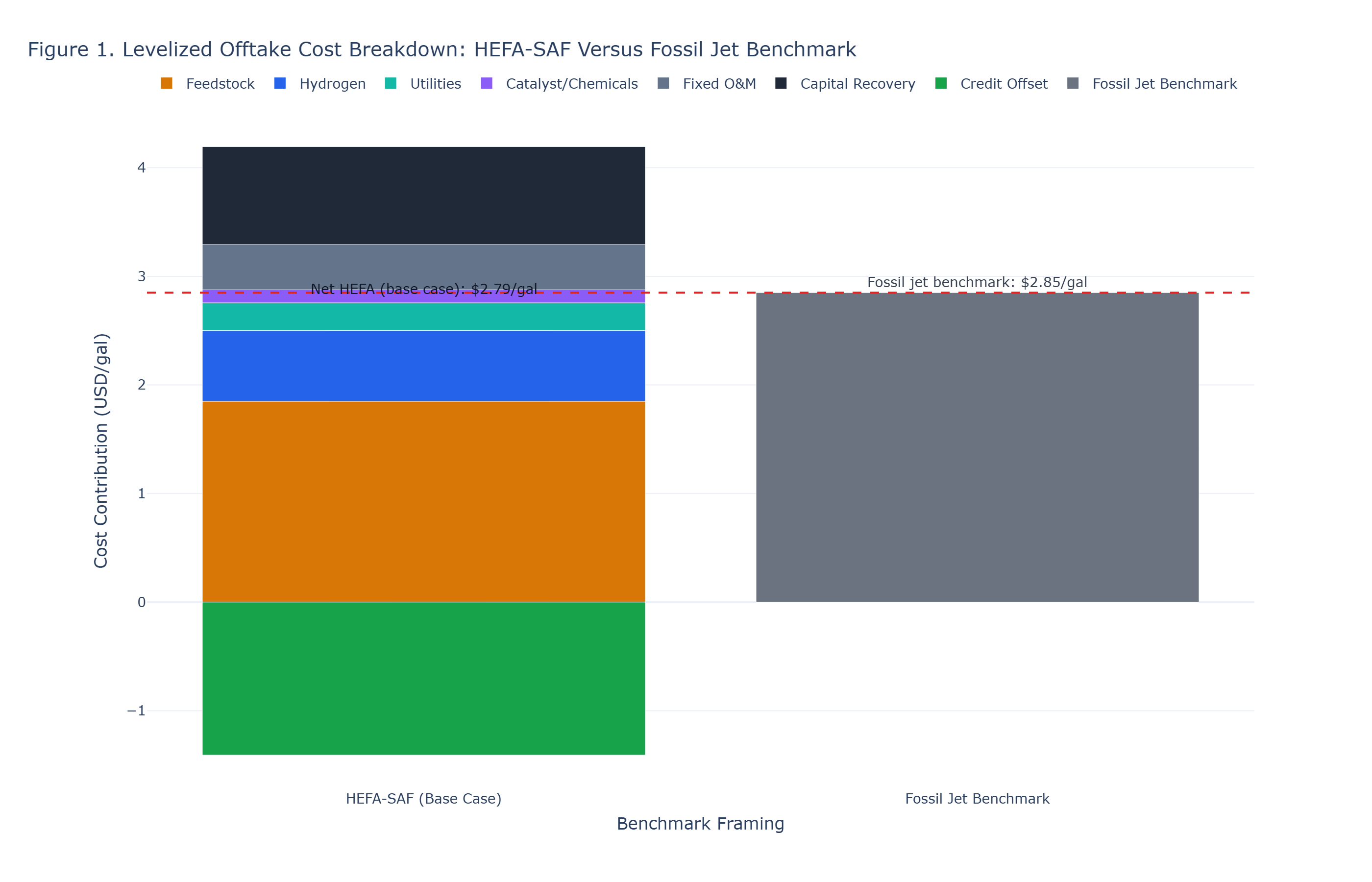
Figure 1 - Benchmark Framing
Figure 1 establishes the delivered fossil-jet benchmark and shows how the modeled credit offsets the HEFA-SAF cost stack.
Figure 1: Base-case benchmark framing. HEFA-SAF cost stack is compared against fossil jet benchmark, with credit offset shown explicitly as a negative segment.
Decision statement
In the base case, HEFA parity requires near-threshold feedstock pricing and fails quickly under moderate feedstock escalation.
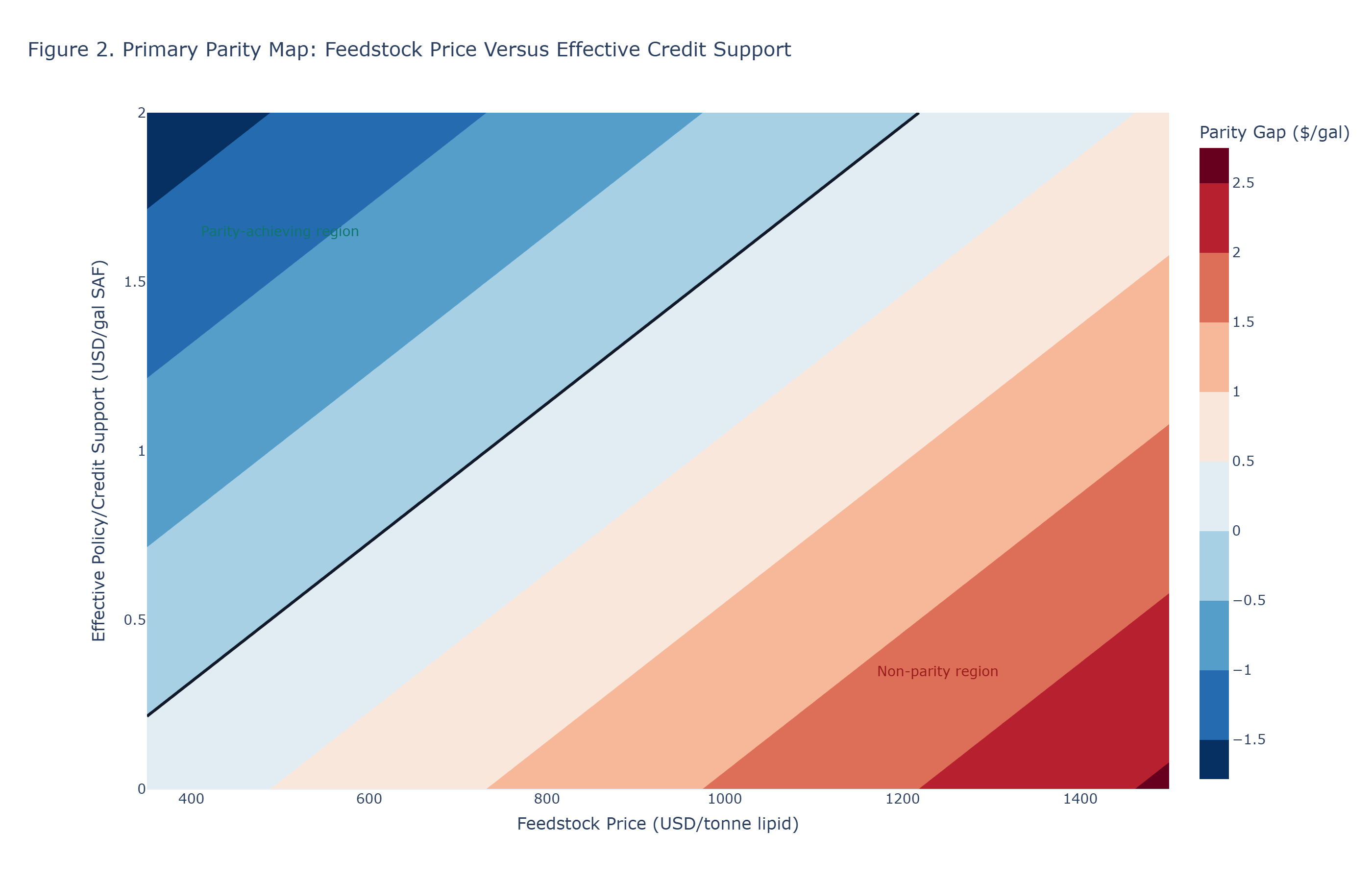
Figure 2 - Primary Parity Map
Figure 2 maps the combinations of feedstock price and realized credit that preserve parity. Read the zero-gap contour as a conditional boundary, not a universal threshold.
Figure 2: Primary parity map. The zero-gap contour marks the viability boundary. Regions below the boundary achieve parity with fossil jet, while regions above do not.
Decision statement
The parity boundary defines a narrow viability region: at modeled base credit support, parity requires feedstock <= ~$931/tonne; above this collapse threshold, the viable region is invalid.
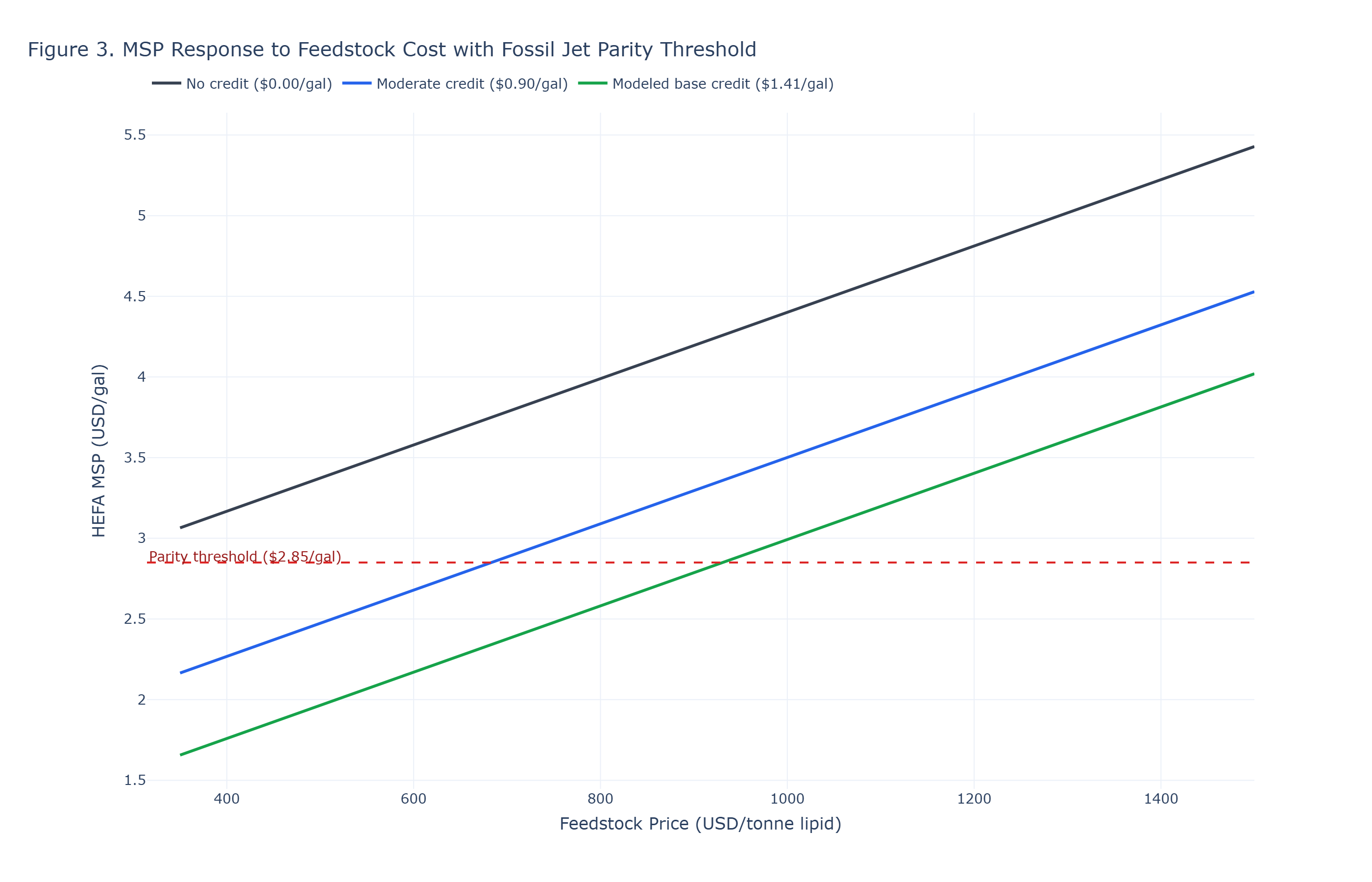
Figure 3 - MSP Response with Parity Threshold
Figure 3 translates credit scenarios into maximum feedstock prices. Focus on how quickly the allowable feedstock ceiling contracts as realized credit falls.
Figure 3: MSP_HEFA response curves under no-credit, moderate-credit, and modeled-credit scenarios with fossil jet parity threshold shown explicitly.
Decision statement
In constrained-credit cases, parity ceilings are explicit: at moderate credit (~$0.90/gal), feedstock must remain <= ~$683/tonne; at no credit, parity is not achievable above ~$245/tonne.
Figure 4 - Fragility Penalty from Feedstock Escalation
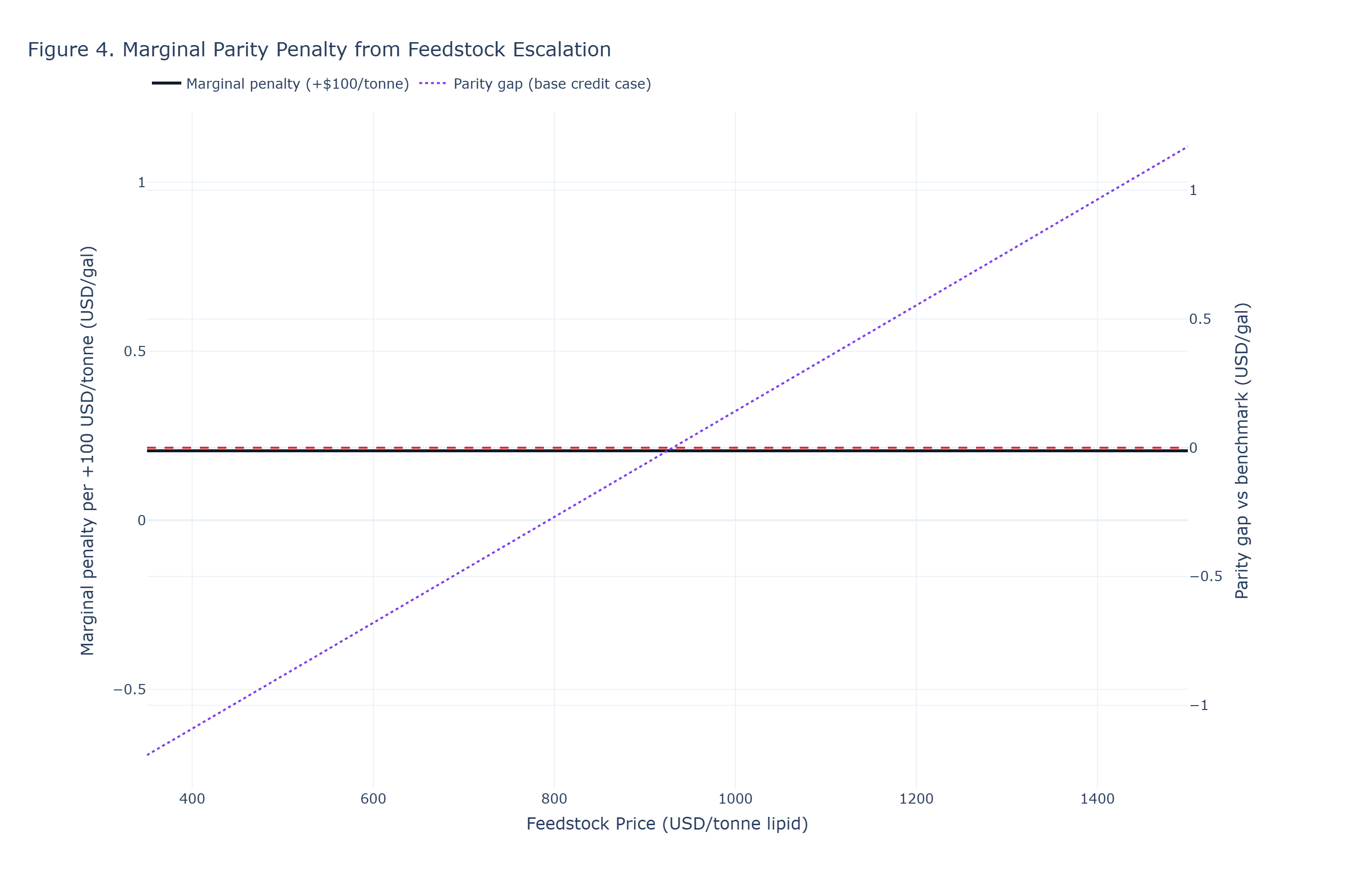
Figure 4 measures the fragility slope: each $100/tonne feedstock increase adds approximately $0.206/gal to modeled MSP.
Figure 4: This figure quantifies the rate at which economic parity deteriorates as feedstock prices rise, providing a direct fragility measure rather than a simple threshold condition.
Decision statement
d(MSP)/d(feedstock) ~= 0.00206 $/gal per $/tonne (equivalently +$0.206/gal per +$100/tonne), indicating persistent structural fragility.
Figure 5 - Decision Summary Figure
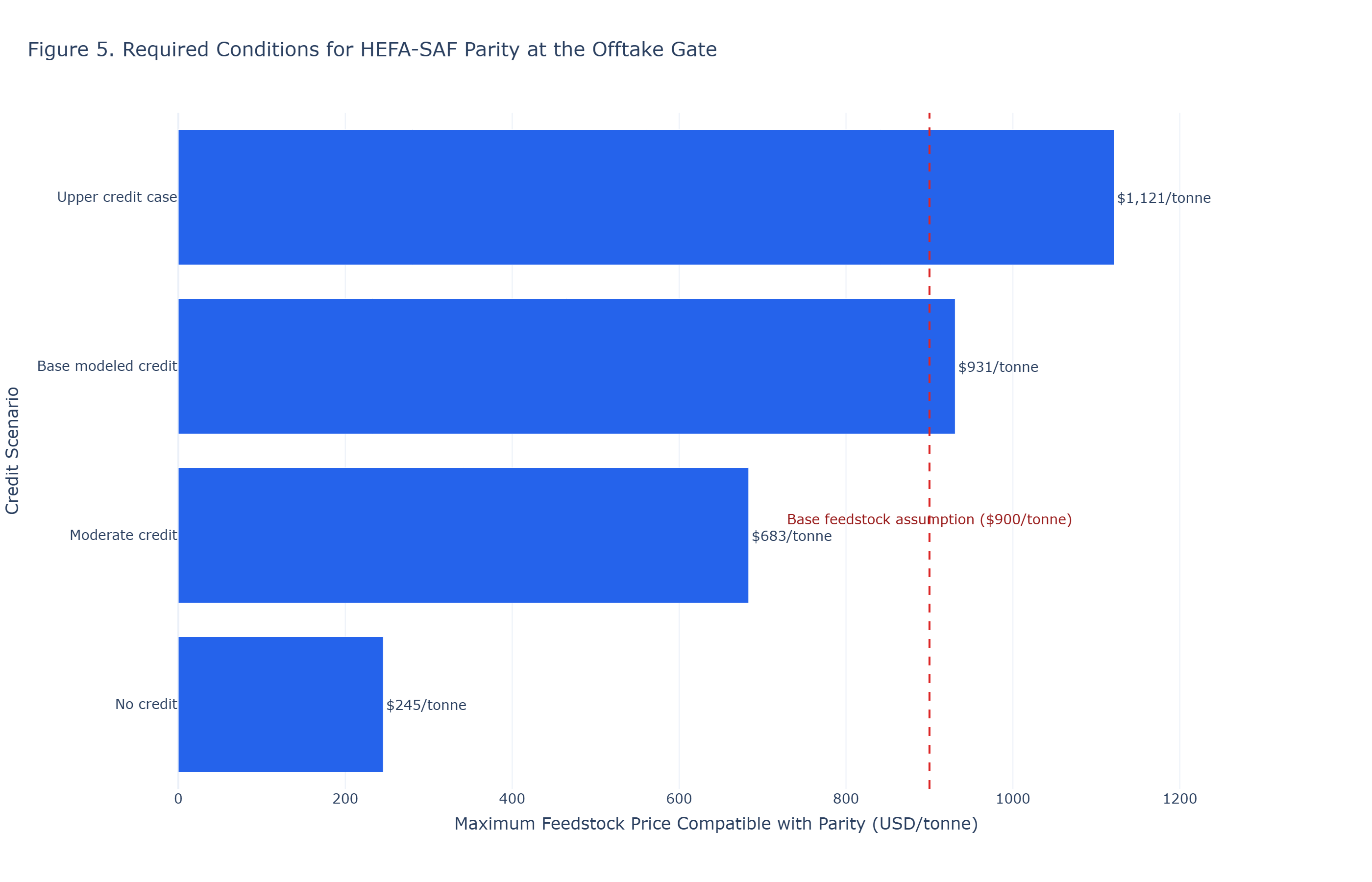
Figure 5 condenses the modeled feedstock ceilings by credit scenario into a board-level decision screen.
Figure 5: Decision summary of required conditions. Maximum feedstock prices compatible with parity are shown by credit scenario for board-level Go/No-Go screening.
Decision statement
Under moderate and low credit support, parity is either highly constrained or impossible at realistic feedstock prices.
Base-case parity headroom is near-degenerate: only ~$31/tonne separates the base feedstock assumption from structural collapse.
Context
1. Decision Context
This note maps the HEFA feasibility boundary under benchmark-consistent steady-state assumptions before persistence stress is applied. Operational degradation variables such as dispatch volatility, outage behavior, and runtime instability are outside this parity layer and belong in the companion feedstock-risk analysis. The analysis applies DG-PFF to test whether HEFA-SAF reaches cost parity under stated feedstock and policy assumptions.
Fragility condition: parity persistence under lipid-price, credit-value, and CI perturbations.
Decision principle: Parity alone is insufficient; viability requires persistence of parity under perturbation.
Method
3. Parity Claim
The parity claim tested is that HEFA-SAF can undercut fossil jet at the offtake gate under current feedstock and credit conditions.
Method
4. Parity Metric
Parity is defined at the boundary where MSP_HEFA equals the delivered fossil jet benchmark cost under stated CI and credit assumptions.
Fragility
5. Fragility Metric
Fragility in this parity-layer note is reported as conditional structural collapse thresholds, not universal operational limits. In the modeled slices, parity fails above roughly $931/tonne feedstock at the $1.41/gal base credit. At the $900/tonne base-feedstock case, parity fails below roughly $1.35/gal effective credit or above roughly 37.4 gCO2e/MJ under the modeled CI-credit mapping. These thresholds shift when benchmark, feedstock, credit, or mapping assumptions change.
Fragility
6. Parity-Fragility Relationship
The structural parity screen defines the feasible boundary under steady-state assumptions; the persistence stress test then evaluates whether that region survives realistic operating and market constraints. The collapse thresholds must be read as points on the modeled feedstock-credit-CI surface, not as independent universal limits.
Method
7. Methods and Traceability
Fossil jet benchmark basis: Fixed $2.85/gal reference benchmark used in the parity equation (assets/data/notes/hefa-cost-parity-vs-fossil-jet/hefa_parity_inputs.json). This is a screening anchor, not a fuel-price forecast.
Fossil benchmark fragility check: Holding other variables constant, a +/-$0.50/gal jet benchmark shift moves the feedstock collapse threshold by approximately +/-243/tonne (from ~688/tonne at $2.35 jet to ~1,174/tonne at $3.35 jet).
Feedstock benchmark basis: Base feedstock assumption $900/tonne with solved parity threshold of ~$930.8/tonne.
Hydrogen basis and stress range: Process hydrogen cost is benchmark-derived from NREL HEFA OPEX ($32.5MM/yr over 50MM gal/yr = ~$0.65/gal). This is not a green-H2 delivered-price assumption. A +$0.25/gal hydrogen cost shock reduces the feedstock collapse threshold by ~122/tonne.
CAPEX derivation: Annual output 50MM gal/yr, total CAPEX $410MM, discount rate 10%, life 25 years (CRF ~11.02%), yielding annualized CAPEX of ~$0.903/gal.
Credit stack basis and CI proxy scope: Max credit modeled at $1.80/gal with CI-linked linear compression from 20 to 89 gCO2e/MJ; decision scenarios include no-credit, moderate-credit ($0.90/gal), modeled base credit (~$1.41/gal), and upper credit case. The CI-credit mapping is a screening proxy and not a scheme-specific implementation of CORSIA, RED III, or LCFS accounting.
Credit policy durability scope: The modeled base credit case (~$1.41/gal) should be interpreted as a stacked-credit screening case; policy durability, stacking eligibility, and reform/sunset risk require explicit sensitivity treatment.
CI threshold interpretation anchor: The ~37.4 gCO2e/MJ collapse threshold is a model-internal proxy threshold derived from the linear CI-credit mapping above. In practical UCO-HEFA screens, feedstock and credit realization are expected to bind before CI, unless pathway CI materially degrades.
Co-product treatment: SAF_HEFA benchmark data includes coproduct credits (-$21.0MM/yr, approximately -$0.42/gal). This parity-layer model excludes explicit coproduct credit in the structural boundary calculation to preserve a conservative screen; adding full coproduct credit would shift the feedstock collapse threshold upward by approximately +204/tonne.
Scenario grid specification: Feedstock sweep $350-$1,500/tonne and effective credit sweep $0.00-$2.00/gal exported to assets/data/notes/hefa-cost-parity-vs-fossil-jet/parity_surface_grid.csv.
Uncertainty method boundary: This note uses deterministic boundary sweeps for structural screening. Stochastic persistence treatment belongs in the companion feedstock-risk analysis and should be read jointly for decision interpretation.
Standalone readability guardrail: Companion feedstock-risk distribution modeling uses a lognormal volatility setting with implied coefficient of variation of ~24%; deterministic collapse margins in this parity screen should be interpreted against that dispersion.
Context
8. Publication Completion Checklist
✓ Figure 1 benchmark framing complete and annotated
✓ Figure 2 primary parity map complete with viability boundary language
✓ Figure 3 MSP response complete with parity-threshold crossings
✓ Figure 4 fragility-penalty metric complete with labeled slope
✓ Figure 5 decision summary complete with threshold windows by credit scenario
✓ Structural claim tied to viability-region collapse
✓ Decision summary updated with final thresholds and confidence tag
✓ Explicit parity-fragility relationship statement included (Section 6)
✓ Feedstock fragility slope disclosed as a decision output
This analysis applies the Decision-Grade Parity-Fragility Framework (DG-PFF), developed by Insight Quantix. This note identifies both parity conditions and the fragility thresholds under which those conditions fail. This analysis extends DG-PFF beyond hydrogen systems, demonstrating applicability to SAF pathways under feedstock-driven cost uncertainty.
Inputs and thresholds: See model equations, threshold tables, and linked artifacts under assets/data/notes/hefa-cost-parity-vs-fossil-jet/.
Reproducibility note: Parity boundaries are most sensitive to feedstock price, effective credit realization, and CI-linked credit compression assumptions.
Disclosure: Insight Quantix derived all analytical conclusions independently; external references provide context only.
Gomez, J. R. (2026). HEFA-SAF Cost Parity vs Fossil Jet: Viability Region Under Feedstock and Credit Constraints (Insight Quantix Analytical Note IQ-AN-SAF-2026-01, v2.0). Retrieved from https://insightquantix.com/hefa-cost-parity-vs-fossil-jet.html
Chicago Format
Gomez, Jamie R. "HEFA-SAF Cost Parity vs Fossil Jet: Viability Region Under Feedstock and Credit Constraints." Insight Quantix Analytical Note IQ-AN-SAF-2026-01, v2.0, June 19, 2026. https://insightquantix.com/hefa-cost-parity-vs-fossil-jet.html.
BibTeX
@techreport{Gomez2026_SAF_Parity,
  author = {Gomez, Jamie R.},
  title = {HEFA-SAF Cost Parity vs Fossil Jet: Viability Region Under Feedstock and Credit Constraints},
  institution = {Insight Quantix},
  year = {2026},
  type = {Analytical Note},
  number = {IQ-AN-SAF-2026-01},
  month = jun,
  url = {https://insightquantix.com/hefa-cost-parity-vs-fossil-jet.html}
}
Method
Appendix A: Modeling Parameters
Model form: See the governing equations and threshold definitions in the technical section of this note.
Primary data artifacts:assets/data/notes/hefa-cost-parity-vs-fossil-jet/
Reproducibility scope: This appendix anchors file locations and parameter traceability for decision-grade review.
Reference
About the Author
Jamie R. Gomez, Ph.D.
Principal, Insight Quantix
Chemical engineer specializing in decision-grade techno-economic analysis (TEA) and life cycle assessment (LCA) for hydrogen, sustainable aviation fuels, and power-to-liquids pathways. She translates process-level engineering models into cost, emissions, and uncertainty insights that inform capital allocation and technology scale-up decisions. Her prior work has supported technology cost-target modeling, scale-up analysis, and decision-oriented TEA/LCA efforts across federally funded clean-energy programs, including collaborations with Sandia National Laboratories, the National Renewable Energy Laboratory, ARPA-E, and clean-energy companies. She holds a PhD in chemical engineering with research focused on electrochemical materials fabrication.
Insight Quantix publishes independent analytical work for transparency, education, and decision clarity. The analysis examines benchmark-anchored, audit-defensible economic risk conditions as public scholarly research.
Legal Disclaimer This analytical note is provided for informational and educational purposes only and does not constitute investment advice, financial advice, engineering design recommendations, or legal interpretation of tax policy. Readers should conduct independent due diligence and consult qualified professionals before making capital allocation decisions. The analysis reflects representative scenarios based on stated modeling parameters and should not be construed as a guarantee of project performance or economic outcomes. Specific project economics require site-specific analysis accounting for local conditions, technology configurations, and regulatory environments. Insight Quantix makes no warranties, express or implied, regarding the accuracy, completeness, or reliability of this information for any particular purpose.